Tuesday, December 17, 2019

Botswana’s Okavango Delta is created by a delicate balance, but for how much longer?

The Okavango Delta in northern Botswana is a mosaic of water paths, floodplains and arid islands. The delta sits in the Okavango river basin, which spans three African countries: Angola, Namibia and Botswana.
Because it’s an oasis, in a semi-arid area, it hosts a rich array of plants and attracts a huge variety of wildlife.


As a unique ecosystem, in 2014 it was placed on UNESCO’s World Heritage list and it is an iconic tourist destination, which generates 13% of Botswana’s GDP.
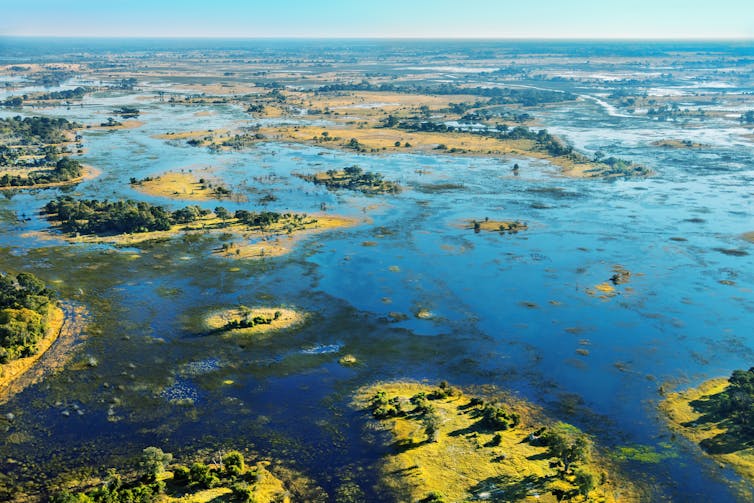
Aerial 
But it’s a fragile natural area. It’s controlled by deformations of the Earth’s crust over a long time (thousands to millions of years) and by annual water flows and evaporation. The size of the flooded delta from year to year varies between 3,500km² and 9,000km² because of weather fluctuations which control its water supply.
Any change to the processes that form the delta will have an impact on the wildlife and local economic activities. Its grassy floodplains are food for grazing animals in the dry period. Losses of this habitat will cause declines in wildlife and livestock. It’s therefore imperative to understand what creates and sustains the delta for the future management of the system.
We have conducted several studies that cover how the Okavango basin was formed and the way dissolved chemicals are withdrawn from the delta’s surface.
The dynamic history of the Okavango Delta’s waterways and floodplains tells us that the interplay between geology, water and plants makes the delta resilient, but vulnerable

Wednesday, December 11, 2019

Time Person of the Year: Greta Thunberg wins accolade for climate activism

Swedish climate change activist Greta Thunberg has been named Time Person of the Year, it was announced on Wednesday. 
“She is an ordinary teenage girl who, in summoning the courage to speak truth to power, became the icon of a generation,” the magazine wrote.

Friday, November 29, 2019

Okavango Wilderness Project


Image may contain: sky, outdoor, water and natureOur first contact with the Cuito River was in 2015, when we explored it by mokoro. Since then we’ve been able to explore it by air, and appreciate this vast land and it’s many waterways. This years biodiversity survey our most ambitious yet, and is probably the largest ecological expedition on the continent this year. Thirty seven researchers have joined us to look at all aspects of this landscape - from hydrology to mycology, butterflies and beetles to flowers and forests. We’ve been here for more than two weeks, and have more than two more to go. Every day has new discoveries, and each offers us another opportunity to better understand this unique place. //
O nosso primeiro contacto com o rio Cuito foi em 2015, quando o navegamos usando mekoros. Desde então já o podemos explorar por ar, e admirar esta terra vasta e os seus inúmeros cursos de água. A pesquisa de biodiversidade deste ano foi a mais ambiciosa até agora e, provavelmente, a maior expedição ecológica deste ano no continente africano. Juntaram-se à nós trinta e sete pesquisadores para analisar todos os aspectos desta paisagem - desde hidrologia à micologia, borboletas e escaravelhos à flores e florestas. Estamos aqui há mais de duas semanas e faltam mais de duas ainda. Descobrimos coisas novas todos os dias e cada um desses dias dá-nos mais uma oportunidade para melhor entender este lugar único.
📷 : Madeleine Foote for #intotheokavango #Mussuma19
Their FB page: Okavango Wilderness Project

Wednesday, November 20, 2019

Joseph Matshelo: The walking library: DR EMILY BENNITT RECEIVES VICE CHANCELLOR'S AWARD ...

Joseph Matshelo: The walking library: DR EMILY BENNITT RECEIVES VICE CHANCELLOR'S AWARD ...: DR EMILY BENNITT RECEIVES VICE CHANCELLOR'S AWARD FOR PUBLISHING Dr Emily Bennitt was awarded the Vice Chancellor’s Award for Publish...

DR EMILY BENNITT RECEIVES VICE CHANCELLOR'S AWARD FOR PUBLISHING

DR EMILY BENNITT RECEIVES VICE CHANCELLOR'S AWARD FOR PUBLISHING
Dr Emily Bennitt was awarded the Vice Chancellor’s Award for Publishing.
Dr Bennitt is among six UB researchers who received awards at the University Research Awards Ceremony the University of Botswana hosted through the Office of Research and Development at the UB Conference Centre on November 15, 2019.
The Research Awards Ceremony is a premier occasion where the University recognises its academics whose research has international impact, whilst remaining locally relevant.
Dr Bennitt first came to Botswana from the United Kingdom in 2007 to conduct her PhD on Cape buffalo in the Okavango Delta. Dr Bennitt has been working at the Okavango Research Institute as a large herbivore ecologist since 2014.
During this time, Dr Bennitt has been involved in projects on zebra, blue wildebeest, impala, tsessebe, springbok, rhino, human-wildlife conflict and leopard.
Dr Bennitt works collaboratively with multiple research organisations in Botswana and beyond. It is through collaboration with the Royal Veterinary College (University of London), that she was able to publish the two Nature papers that have earned her this award.

Wednesday, November 13, 2019

UB SECRETARIES DONATED HOUSE WORTH P210 000

A group of 60 University of Botswana secretaries has donated a house worth P210 000 to Mr Kitso Otlogetswe, a UB alumnus living with disability. The two-bedroomed house which also has a screen wall and fitted kitchen was donated at Tsolamosese on November 8, 2019.
The initiative to build Mr Otlogetswe who was then a UB student a house, was launched in 2013. The team identified Mr Otlogetswe as a needy person through the UB Disability Support Services Unit and given his health condition then, the aim was to improve his living condition.
Spurred on by an unwavering commitment to realise their dream, the team engaged stakeholders such as Mogoditshane Land Board to acquire a plot for Mr Otlogetswe.
They financed the project through monthly contributions which they augmented with pledges from good Samaritans in the community. After completion of his academic studies, Mr Otlogetswe secured a job in the Ministry of Health and Wellness. Such came as a huge blessing as he also got involved and contributed some money towards the project as well.
Speaking at the handing over ceremony, Vice Chancellor, Professor David Norris, said the donation was a demonstration of love, care and compassion towards others especially the less privileged.
Professor Norris said the donation was in line with the UB mission of impacting positively on society. The house is still to be fitted with a ceiling and the Vice Chancellor made a pledge of P10 000 from the University towards the project.
UB HIV/AIDS Office Coordinator, Dr Roy Hanganiso said the donation was a living demonstration of Setswana cultural values such as care, love, unity and respect. He said it also demonstrated how the university was established through the spirit of self-help.
Tsolamosese Councillor, Mr Shaka Ditshube, commended UB for its commitment towards assisting underprivileged members of the community. Mr Ditshube also advised the beneficiary, Mr Otlogetswe, to work together with the community.
Meanwhile, Mr Otlogetswe expressed his appreciation at the UB team for having found it fit to assist him with accommodation closer to Gaborone because he would be able to go for medical attention easily. He also thanked the University management for the love and support he received during his stay at UB.

Monday, October 7, 2019

Why Okavango Delta is drying - experts speak

The country's most treasured tourism asset, the Okavango Delta, is experiencing one of the driest periods in its history. As a World Heritage Site, the Delta's drying has stoked fears that Botswana is witnessing the beginning of the end of the magic. Staff Writer, THALEFANG CHARLES, speaks to the experts studying the matter

Exactly 100 years since Batawana’s first relocation after settling in Ngamiland, Maun is staring at the worst drought in recent history. It is not just Maun. The entire south western part of the Okavango Delta is as dry as a bone. 
The annual flood from the Okavango’s catchment was at its lowest levels this year. The low water found empty rivers and it is unlikely that the trickle will reach Maun this year. 
If we were still in the 1800s, Kgosi Kealetile Moremi would be relocating from Maun now.
Historical records show that in 1820 Kwebe, the first capital of Batawana, located on the foothill of Kwebe Hills and peripheries of Lake Ngami, dried up forcing the then Kgosi Moremi to move to Namanyana, which is the current day Toteng.  After Toteng there were many relocations - to Tshoroga, back to Toteng, then Tsau, before a final settlement in Maun in 1915.
These relocations were mainly due to droughts (drying of rivers) and natural disasters involving diseases such as Rinderpest.
Most of the Batawana royal settlements (Mauns) were concentrated on the western part of the Okavango Delta and around Lake Ngami that was fed by the Thaoge River.
Thaoge River is one of the three main splits of the Okavango Delta. Others are the Nqoga – Maunachira – Khwai and the Jao – Boro systems. The Thaoge River flow into Lake Ngami died in the mid-1900s. Is the Jao-Boro system next on the line, especially looking at its current state?  Is the Okavango Delta dying?
Mmegi invited experts, who have extensively worked on the Okavango River Basin to explain the status of the current water levels.

Hope in Aging and Dementia!