Tuesday, February 25, 2020

FACULTY OF HEALTH SCIENCES PHD STUDENT AND SANTHE FELLOW SCOOPS HUCFAR AWARD

Dr Kaelo Seatla, a PhD student in Medical Science in the Faculty of Health Sciences has received a highly competitive and prestigious one-year Harvard University Center for AIDS Research (HU CFAR) Developmental Award grant valued at US$60 000 (around P600 000).
Dr Seatla is also a SANTHE Fellow based at the Botswana Harvard Partnership site. He received the grant for his project entitled, “Genotyping/Phenotyping subtype-C HIV-1 from patients failing DTG-ART, Botswana”.
The main aim of the study is to perform a complete genotypic and phenotypic characterisation of HIV subtype-C viruses from individuals failing dolutegravir (DTG)-based regimens.
The study has potential to unravel novel DTG drug resistance mutational pathways specific to HIV subtype-C virus and improve patient care. This study is an extension of the current PhD work that Dr Seatla is doing.
Dr Seatla will have the opportunity to work in Dr. Daniel Kuritzkes’ laboratory in USA where he will learn novel phenotypic HIV drug resistance testing assays that he hopes to transfer to Botswana for use in scientific research and patient care.
Dr Seatla is grateful to Dr Shahin Lockman (Harvard University), Dr Simani Gaseitsiwe (BHP), Professor Ishmael Kasvosve (UB), Dr Ava Avalos (BHP) and Dr Sikhulile Moyo (BHP) for their support and mentorship.
The HU CFAR welcomes proposals for Developmental Awards for research in all HIV-related disciplines on an annual basis. The awards provide both salary and research support for promising early-career investigators who are transitioning to independent funding.

Thursday, January 23, 2020

World Wetlands Day 2020

World Wetlands Day 2020
Our rivers are drying, our livestock and wildlife are dying - Take action, save lives by conserving our wetlands.

Tuesday, December 17, 2019

Botswana’s Okavango Delta is created by a delicate balance, but for how much longer?

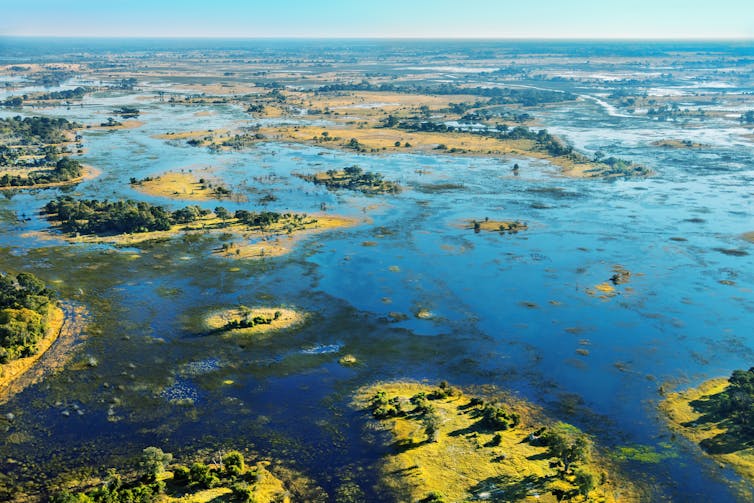
The Okavango Delta in northern Botswana is a mosaic of water paths, floodplains and arid islands. The delta sits in the Okavango river basin, which spans three African countries: Angola, Namibia and Botswana.
Because it’s an oasis, in a semi-arid area, it hosts a rich array of plants and attracts a huge variety of wildlife.


As a unique ecosystem, in 2014 it was placed on UNESCO’s World Heritage list and it is an iconic tourist destination, which generates 13% of Botswana’s GDP.

Aerial 
But it’s a fragile natural area. It’s controlled by deformations of the Earth’s crust over a long time (thousands to millions of years) and by annual water flows and evaporation. The size of the flooded delta from year to year varies between 3,500km² and 9,000km² because of weather fluctuations which control its water supply.
Any change to the processes that form the delta will have an impact on the wildlife and local economic activities. Its grassy floodplains are food for grazing animals in the dry period. Losses of this habitat will cause declines in wildlife and livestock. It’s therefore imperative to understand what creates and sustains the delta for the future management of the system.
We have conducted several studies that cover how the Okavango basin was formed and the way dissolved chemicals are withdrawn from the delta’s surface.
The dynamic history of the Okavango Delta’s waterways and floodplains tells us that the interplay between geology, water and plants makes the delta resilient, but vulnerable

Wednesday, December 11, 2019

Time Person of the Year: Greta Thunberg wins accolade for climate activism

Swedish climate change activist Greta Thunberg has been named Time Person of the Year, it was announced on Wednesday. 
“She is an ordinary teenage girl who, in summoning the courage to speak truth to power, became the icon of a generation,” the magazine wrote.

Friday, November 29, 2019

Okavango Wilderness Project


Image may contain: sky, outdoor, water and natureOur first contact with the Cuito River was in 2015, when we explored it by mokoro. Since then we’ve been able to explore it by air, and appreciate this vast land and it’s many waterways. This years biodiversity survey our most ambitious yet, and is probably the largest ecological expedition on the continent this year. Thirty seven researchers have joined us to look at all aspects of this landscape - from hydrology to mycology, butterflies and beetles to flowers and forests. We’ve been here for more than two weeks, and have more than two more to go. Every day has new discoveries, and each offers us another opportunity to better understand this unique place. //
O nosso primeiro contacto com o rio Cuito foi em 2015, quando o navegamos usando mekoros. Desde então já o podemos explorar por ar, e admirar esta terra vasta e os seus inúmeros cursos de água. A pesquisa de biodiversidade deste ano foi a mais ambiciosa até agora e, provavelmente, a maior expedição ecológica deste ano no continente africano. Juntaram-se à nós trinta e sete pesquisadores para analisar todos os aspectos desta paisagem - desde hidrologia à micologia, borboletas e escaravelhos à flores e florestas. Estamos aqui há mais de duas semanas e faltam mais de duas ainda. Descobrimos coisas novas todos os dias e cada um desses dias dá-nos mais uma oportunidade para melhor entender este lugar único.
📷 : Madeleine Foote for #intotheokavango #Mussuma19
Their FB page: Okavango Wilderness Project

Wednesday, November 20, 2019

Joseph Matshelo: The walking library: DR EMILY BENNITT RECEIVES VICE CHANCELLOR'S AWARD ...

Joseph Matshelo: The walking library: DR EMILY BENNITT RECEIVES VICE CHANCELLOR'S AWARD ...: DR EMILY BENNITT RECEIVES VICE CHANCELLOR'S AWARD FOR PUBLISHING Dr Emily Bennitt was awarded the Vice Chancellor’s Award for Publish...

DR EMILY BENNITT RECEIVES VICE CHANCELLOR'S AWARD FOR PUBLISHING

DR EMILY BENNITT RECEIVES VICE CHANCELLOR'S AWARD FOR PUBLISHING
Dr Emily Bennitt was awarded the Vice Chancellor’s Award for Publishing.
Dr Bennitt is among six UB researchers who received awards at the University Research Awards Ceremony the University of Botswana hosted through the Office of Research and Development at the UB Conference Centre on November 15, 2019.
The Research Awards Ceremony is a premier occasion where the University recognises its academics whose research has international impact, whilst remaining locally relevant.
Dr Bennitt first came to Botswana from the United Kingdom in 2007 to conduct her PhD on Cape buffalo in the Okavango Delta. Dr Bennitt has been working at the Okavango Research Institute as a large herbivore ecologist since 2014.
During this time, Dr Bennitt has been involved in projects on zebra, blue wildebeest, impala, tsessebe, springbok, rhino, human-wildlife conflict and leopard.
Dr Bennitt works collaboratively with multiple research organisations in Botswana and beyond. It is through collaboration with the Royal Veterinary College (University of London), that she was able to publish the two Nature papers that have earned her this award.

Hope in Aging and Dementia!