Tuesday, September 8, 2020

September 08, is International Literacy Day

 It was established to highlight the importance of literacy to individuals, communities and societies. Statistics show that over 90% of Botswana’s population is literate.

The ability to read should not be misconstrued as a culture of reading. Botswana actually has a terribly poor culture of reading. People rarely read. Holt (1998) has remarked that a situation in which a large number of people rarely read, either because they lack the skill or simply because they do not care enough to take time to concentrate will pose serious problems in the future. This is precisely because reading is essential to full participation in modern society. For one to participate meaningfully in democracy, reading is essential. For one to participate in business and to communicate clearly, they must read without fear. Voracious reading emancipates and strengthens an individual. It adds quality to life, provides access to culture and cultural heritage, empowers and emancipates citizen as well as bringing people together. In the words of Sisulu (2004), reading is one of the fundamental building blocks of learning; to be fair, it is a fundamental necessity to participating in the rigorous life of the 21st Century.
The importance of reading is fairly well-known. Successful academic life cannot be without considerable amounts of reading. All academic pursuits are based on wide reading. Right from pre-primary level until university and post university study, learning depends on reading. To read improves the quality of a people; it opens doors of cultural exchange and national heritage. It is through reading that we recognize that we are one people; that amongst the Kalanga, there are those of Sotho roots and those with Ndebele linkages; that amongst the Bangwaketse are the Bakgatla, Bangwato, Bahurutshe, Batshweneng, Bangologa and many others. Reading opens your mind delivers you from narrow tribal interests and exposes you to the complexity of modern society. It shows you that there is no pure tribe; that we are forever inextricably bound together as a people; that our cultures may be unique, but that they all derive from one source. Reading can therefore be a vehicle that links persons from continent to continent, from one culture to another, from different religions and faiths as well as from different interests.
Reading opens a new world to the reader; sometimes it is an imaginary world, while sometimes it is a world physically removed from one’s vicinity. When one reads, they enter into a world of which the non-reader is deprived. Therefore in the sense of the romantic poets of old, such as William Wordsworth and Taylor Coleridge, reading is a liberating tool that takes one into new worlds.
Reading accords a reader, time to explore the world of books in quietude. Reading is rarely done in disco halls and the noisy and smoke filled club houses. It normally happens in silent rooms according the reader valuable time of reflection and introspection. The material being read may be mentally disturbing to the reader, perhaps as it should, but it disturbs a calm and searching mind that is receptive to the literary world. That is why religious people find a time of consulting the whole book most rewarding since it is done so in a silent and focused moment.
The culture of reading safe-guards a reader from useless rumour mongering and enables a reader to read and/or consult the original sources. Reading therefore exposes the truth – whatever it may be seen to be at a particular time. That is why it is somewhat disheartening to see parliamentarians who haven’t read attempting to make a contribution in the house and looking incredibly uninformed. The honourable MP must be encouraged to read so that when she approaches national matters she does so with facts and not hearsays which take parliamentary debates nowhere.
Reading is important since it aids a reader to better their self expression. Good readers usually make excellent writers. This is important for students, academics, PRO personnel, religious leaders, business leaders and many others. If one wishes to express themselves clearly and forcedly, they must cultivate the habit of reading. This is in part because reading exposes one to new words, new phraseology and idiomatic expressions. It therefore betters individual linguistic dexterity.
Reading is a discipline exercise. It trains one to stay focused on one matter and to see it to completion. This trains the brain to stay focused on one issue instead of touching on a number of matters at the same time. Reading exercises the brain just like physical exercise strengthens the brain. It has been found out that old people who read, religiously continue to be mentally alert. We must therefore continue to encourage extensive reading amongst our people. Parents who read usually have children who read. Parents who bury their faces in their phones and televisions must not criticize their children for being reluctant readers. Happy International Literacy Day!

Wednesday, June 10, 2020

EDUCATION MINISTER CONTENT WITH UB COVID-19 HEALTH PROTOCOLS

The Minister of Tertiary Education, Research Science and Technology, Dr Douglas Letsholathebe, visited the University of Botswana on June 8, 2020 to assess and appreciate its readiness and compliance with COVID-19 health protocols.
The minister was pleasantly delighted that as the country’s premier institution of higher learning, the University of Botswana’s compliance with COVID-19 health protocols was top notch. He was later taken around campus to assess and appreciate measures put in place against COVID-19.
Dr Letsholathebe said the University of Botswana had demonstrated leadership and intellectual capacity to move Botswana forward. He said he was proud that since the advent of COVID-19 the University of Botswana embarked on a number of initiatives that underpinned Botswana’s ability to manage the pandemic.
Dr Letsholathebe assured the management that he would do all he could to make sure that the University of Botswana played bigger role in the development of the country through constant engagement with government.
He urged UB academics to come up with position papers on issues that could help guide the national development agenda. He further encouraged the academics to take advantage of new technologies and intensify online teaching.
Acting Deputy Vice Chancellor Academic Affairs, Professor Happy Siphambe, briefed the minister on measures put in place to mitigate the impact of COVID-19 especially on teaching and learning.
Professor Siphambe said online teaching was being accelerated and students were being provided with internet data loaded simcards to access online services even outside campus.
He added that some spaces such as the campus indoor sports centre had been configured as learning spaces in addition to the Botswana Public Service College offering a hall for teaching and learning. Regarding the teaching staff, he said they had been offered soft loans to purchase laptops for remote teaching.
Professor Siphambe noted that the plan was to have the teaching calendar finish in July ahead of the new academic year that was expected to start mid August. Chairperson of the UB COVID-19 Response Team, Dr Chilindi Maloiso, briefed the minister on processes they had embarked on to manage or combat the spread of COVID-19 on campus.
The measures include body temperature checks, registering and sanitizing everyone entering campus. Furthermore, people were required to wear masks in public spaces, observe social distancing at all times. Precautionary notices have been placed around campus especially in high-risk areas such as the student centre, library, student hostels as well as the cafeteria.
Dr Maloiso said there was also constant monitoring and surveillance besides 24hr emergency telephone line in the event there was a suspected case of COVID-19.
In addition, Dr Maloiso revealed that some rooms had been reserved at the student hostels in case there was need for quarantine while the clinic was also available for isolation.
Dr Maloiso explained that international travel for staff was still suspended while areas such as the sports field and gymnasium remained closed.

Wednesday, June 3, 2020

UB ADOPTS BLENDED TEACHING AND LEARNING TO MITIGATE IMPACT OF COVID-19

VC Prof Norris
The University of Botswana will spend P7.8 million to provide students with free simcards as part of measures to mitigate the impact of COVID-19 on teaching and learning.
Acting Deputy Vice Chancellor Student Affairs, Mrs Motsei Rapelana, revealed this during a COVID-19 health protocols orientation for students at UB this week. The university is preparing to resume academic activities next week following suspension of classes in April.
A number of measures have been put in place to prevent and manage the spread of COVID-19 on campus. These include social distancing and avoiding crowding in lecture rooms and other learning spaces.
As such, Mrs Rapelana said the university has signed a P7.8 million Memorandum of Understanding with Botswana Telecommunications Corporation to supply each student with a simcard. The simcard will be loaded with internet data for students to download learning material.
Mrs Rapelana, therefore, encouraged students to always check emails, social media platforms as well as the UB website for updates as new developments emerge now and then.
Similarly, Vice Chancellor, Professor David Norris, echoed Mrs Rapelana’s sentiments about the "new normal" of doing business for the university. Professor Norris explained that blended teaching and learning would now become the "new normal" to ensure safety and compliance with COVID-19 health protocols on campus.
That means blending conventional teaching with remote teaching is the "new normal", he added. He further emphasized that the university would do everything possible to make sure that teaching and learning was “as effective as if there was no corona virus”. While conceding that these were trying times, he nonetheless appealed to everyone to try as much as possible not to compromise the situation on campus.
“These are trying times indeed but please let us try as much as we can to adhere to simple regulations on campus. It is for your own good and for the health of everyone,” said Professor Norris. The Vice Chancellor acknowledged that there would be often inconveniences but such was the new normal that everyone must get used to.
Chairman of the UB COVID-19 Response Team, Dr Chilindi Maloiso, added that reality demanded adoption of safe living together lest we all perish. Consequently, he highlighted some of the measures put in place to prevent or slow down the spread of the corona virus on campus.
Dr Maloiso said movement in and around campus would be highly monitored as part of disease surveillance measures. He also urged the UB community to report any suspicious activity that might militate against prevention of the spread of COVID-19. Dr Maloiso cautioned people against self-diagnosis but to do self-screening and immediately contact the UB clinic or any health facilities should they suspect COVID-19 symptoms.

Thursday, March 12, 2020

Ngami DHMT confirms corona suspect case

Ngami District Health Management Team (DHMT) has confirmed one suspected case of COVID-19 in one of the camps at the Okavango Delta.
Briefing councillors in Maun on March 10, an official from DHMT, Dr Sandra Maripe, said samples taken from the 75-year-old American woman who was showing signs of being unwell has since been taken to the laboratory for further tests. 
She said the woman had also been self-quarantined.
The woman, who is a tourist, travelled from Italy via Cape Town, South Africa to the Okavango Delta.
Dr Maripe informed councillors that the testing was done in South Africa.
She explained that Matshwane Clinic was set aside as an isolation centre. She stated that all tourists coming to Botswana were taken through the screening process.
The deputy council chairperson, Mr Lekone Masoko, thanked the DHMT for allaying fears noting that the rumours were causing confusion among the communities and appreciated that fellow councillors would now be in a position to relay the correct information to the public.
Specially elected councillor, Brigadier Letsogile Motsumi, thanked DHMT for sharing the information and wished the health officials could appraise Batswana about provinces which had been affected in South Africa.
He said by knowing the provinces, Batswana could avoid going to the affected areas. 
Brig. Motsumi also called on health officials not to focus on the major port of entry only, adding that they should also consider small ports of entry citing Dobe in the Ngamiland District as one of them. 
He expressed wish that all ports of entry could be equipped with enhanced public health services to tackle the virus. 
The council chairperson, Mr Kebareeditse Ntsogotlho, said DHMT was on its toes due to the threat posed by COVID-19. 
He said measures were in place to safeguard the district against the disease included the screening of all international arrivals at the ports of entry. 
He said to date, a total of 2 531 visitors in the district had been screened of which 371 were from the affected areas and were cleared to enter.
He said Matshwane Clinic and Eye Clinic at Gumare Primary hospital were set aside as isolation centres while mini holding sites had been identified at both the airport and Letsholathebe Memorial hospital accident and emergency room.
Mr Ntsogotlho noted that the district had also activated the public health emergency and rapid response teams.
He advised the public to follow simple hygiene practices to protect themselves by avoiding close contact with people suffering from acute respiratory disease, frequent hand wash with soap while people with respiratory disease were encouraged to practice cough etiquette. 

Tuesday, February 25, 2020

FACULTY OF HEALTH SCIENCES PHD STUDENT AND SANTHE FELLOW SCOOPS HUCFAR AWARD

Dr Kaelo Seatla, a PhD student in Medical Science in the Faculty of Health Sciences has received a highly competitive and prestigious one-year Harvard University Center for AIDS Research (HU CFAR) Developmental Award grant valued at US$60 000 (around P600 000).
Dr Seatla is also a SANTHE Fellow based at the Botswana Harvard Partnership site. He received the grant for his project entitled, “Genotyping/Phenotyping subtype-C HIV-1 from patients failing DTG-ART, Botswana”.
The main aim of the study is to perform a complete genotypic and phenotypic characterisation of HIV subtype-C viruses from individuals failing dolutegravir (DTG)-based regimens.
The study has potential to unravel novel DTG drug resistance mutational pathways specific to HIV subtype-C virus and improve patient care. This study is an extension of the current PhD work that Dr Seatla is doing.
Dr Seatla will have the opportunity to work in Dr. Daniel Kuritzkes’ laboratory in USA where he will learn novel phenotypic HIV drug resistance testing assays that he hopes to transfer to Botswana for use in scientific research and patient care.
Dr Seatla is grateful to Dr Shahin Lockman (Harvard University), Dr Simani Gaseitsiwe (BHP), Professor Ishmael Kasvosve (UB), Dr Ava Avalos (BHP) and Dr Sikhulile Moyo (BHP) for their support and mentorship.
The HU CFAR welcomes proposals for Developmental Awards for research in all HIV-related disciplines on an annual basis. The awards provide both salary and research support for promising early-career investigators who are transitioning to independent funding.

Thursday, January 23, 2020

World Wetlands Day 2020

World Wetlands Day 2020
Our rivers are drying, our livestock and wildlife are dying - Take action, save lives by conserving our wetlands.

Tuesday, December 17, 2019

Botswana’s Okavango Delta is created by a delicate balance, but for how much longer?

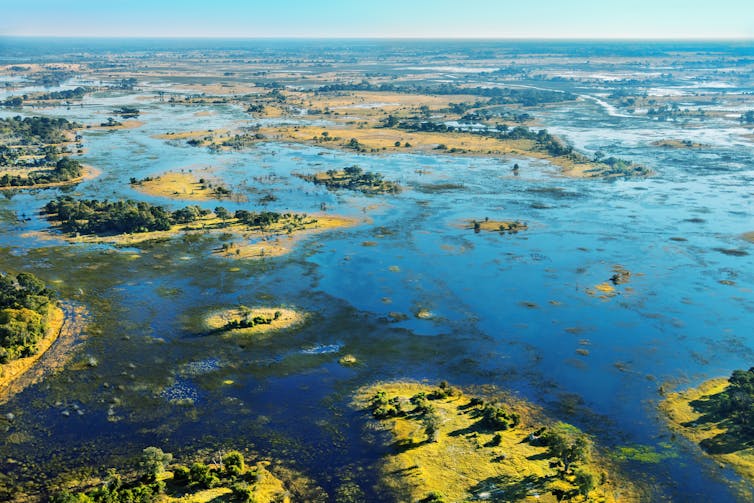
The Okavango Delta in northern Botswana is a mosaic of water paths, floodplains and arid islands. The delta sits in the Okavango river basin, which spans three African countries: Angola, Namibia and Botswana.
Because it’s an oasis, in a semi-arid area, it hosts a rich array of plants and attracts a huge variety of wildlife.


As a unique ecosystem, in 2014 it was placed on UNESCO’s World Heritage list and it is an iconic tourist destination, which generates 13% of Botswana’s GDP.

Aerial 
But it’s a fragile natural area. It’s controlled by deformations of the Earth’s crust over a long time (thousands to millions of years) and by annual water flows and evaporation. The size of the flooded delta from year to year varies between 3,500km² and 9,000km² because of weather fluctuations which control its water supply.
Any change to the processes that form the delta will have an impact on the wildlife and local economic activities. Its grassy floodplains are food for grazing animals in the dry period. Losses of this habitat will cause declines in wildlife and livestock. It’s therefore imperative to understand what creates and sustains the delta for the future management of the system.
We have conducted several studies that cover how the Okavango basin was formed and the way dissolved chemicals are withdrawn from the delta’s surface.
The dynamic history of the Okavango Delta’s waterways and floodplains tells us that the interplay between geology, water and plants makes the delta resilient, but vulnerable

Hope in Aging and Dementia!