Thursday, April 20, 2023

                                                        UNIVERSITY OF BOTSWANA


                                                          FACULTY OF MEDICINE

Call for Application for Bachelor of Medicine Bachelor of Surgery Degree (MBBS) August 2023

Background: The Faculty of Medicine at the University of Botswana (UB) offers both under-graduate (MBBS) and post-graduate (MMed) degrees. The Faculty prides itself with following the World Federation of Medical Education (WFME) standards and a problem-based learning approach, working with local health centres (clinics and hospitals) as well as health professional bodies.

Please be informed that the University of Botswana undergraduate study programmes are all registered with the Botswana Qualifications Authority (BQA).

This announcement invites applications for the undergraduate training programme, the Bachelor of Medicine, Bachelor of Surgery (MBBS), in the Faculty, for the August 2023 enrollment. The MBBS programme is fully accredited with the Botswana Qualifications Authority (BQA). For more information about UB programmes please visit the following UB websites: (www.ub.bw) and (www.ubotho.net).

All who successfully complete this programme will be awarded an MBBS degree from the University of Botswana and will qualify for registration with the Botswana Health Professions Council as medical practitioners.

Entry Requirements:

1. Applicants may be admitted upon successful completion of Level 100 of Bachelor of Science (General) programme from University of Botswana or equivalent qualifications from other institutions with a cumulative grade point average (CGPA) of 3.5. Applicants should have passed Chemistry and two additional science subjects from Mathematics, Biology, Physics with a minimum cumulative grade point average (CGPA) of 3.0 for each course.

2. Holders of A’ level qualifications with a minimum grade point of 3.0 in Chemistry and two additional science subjects from Mathematics, Biology, Chemistry Physics will be considered for direct entry into the MBBS programme.

3. Holders of a Bachelor’s degree qualification with a minimum of Second Class Upper Division (2(i)) and had at least two sciences in the first year of the qualification are also eligible to apply.

Please note that re-applications will also be considered, though their Level 100 grades in CHEMISTRY and TWO additional subjects (Biology, Mathematics & Physics) will be used. First applicants who are currently beyond level 100 will be considered as well, and their level 100 grades in CHEMISTRY and two additional subjects (Biology, Mathematics & Physics) will be considered.

Prospective applicants are expected to scan and save separately, preferably in pdf format, all the required documents in readiness for uploading during application:

▪ receipt for a fully paid Application Fee (for external applicants only)

▪ certified copy of the Omang for citizens or Passport for other nationalities

▪ certified copy of transcript(s)

▪ certified copy of post-school qualification (where applicable),

Closing date: Applications will close on 23rd June 2023 for both local and international applicants.

Applicants who fulfil criteria for selection will be shortlisted and will undergo a further selection process. Those who are successful will be notified by mid-July 2023 and must be available to start training at the beginning of August 2023.

For enquiries on the application process contact Mr. Solomon Mogapi at mogapis@ub.ac.bw , +267 355 4763, Mr. Moagisi Mogalakwe at mogalakwem@ub.ac.bw, phone +267 355-2784 or Faculty of Medicine at fomenquiries@ub.ac.bw or +267 355 4189.

Thursday, November 10, 2022

PHUTHEGO TO RAISE FUNDS FOR HUMAN WILDLIFE CONFLICT VICTIMS IN KAZA COUNTRIES

 Maun based athlete and mountaineering, Simmon Phuthego has launched an organization aimed at raising funds for affected human wildlife conflict victims and promote co-existence, conservation and raising awareness about the situation within the Kavango Zambezi Transfrontier Conservation (KAZA) countries namely Botswana, Namibia, Angola, Zambia and Zimbabwe.


When speaking at Speaking at the first High Level Stakeholder Engagement Breakfast meeting held in Maun recently, where he launched his organization dubbed ‘THE SIMMON PHUTHEGO ORGANISATION’, highlighted that the NGO will raise funding to support adaptation and mitigation of human-wildlife conflict at the local level in all five KAZA countries.
Phuthego first assignment will began next month on the 3rd of December where they will host their inaugural bushwalk in Botswana called ‘THE KAZA CO-EXISTENCE CHARITY BUSH WALK’.
The first beneficiaries of the funds are two victims of crocodile attack in Maun. The duo is Nkoketsang Monnawatsheko, 59, and her daughter Cecilia Monnawatsheko, 40. The two were harvesters of tswii (water lily) that is found in the Okavango and Thamalakane River. They escaped death by a whisker after they were attacked by a deadly crocodile when they were harvesting tswii in 2020. Both women lost an arm after the incident and are now permanently disabled.
The increase in crocodile human conflict could see an increase in poverty levels especially in remote areas since women, who risk their lives to eke a living through harvesting tswii, are mostly the ones affected.
For Monnawatsheko and her daughter Cecilia, their means of survival has drastically changed as they no longer harvest or sell tswii in Maun old mall after their arms were detached by the deadly reptile two years ago.
In a previous interview, Monnawatsheko explained that after the incident the government only paid for medical expenses then abandoned them without any monetary compensation despite being permanently disabled.
Only a few companies came to their rescue to buy them groceries but it is not sustainable and they appeal to the government to at least compensate them with a living allowance to sustain their lives than to rely on donations from Good Samaritans.
The NGO will also assist the family with artificial hands and groceries and will also be counselled for trauma.

Tuesday, March 15, 2022

Okavango Research Institute Donates Old Newspapers to Maun Secondary Schools

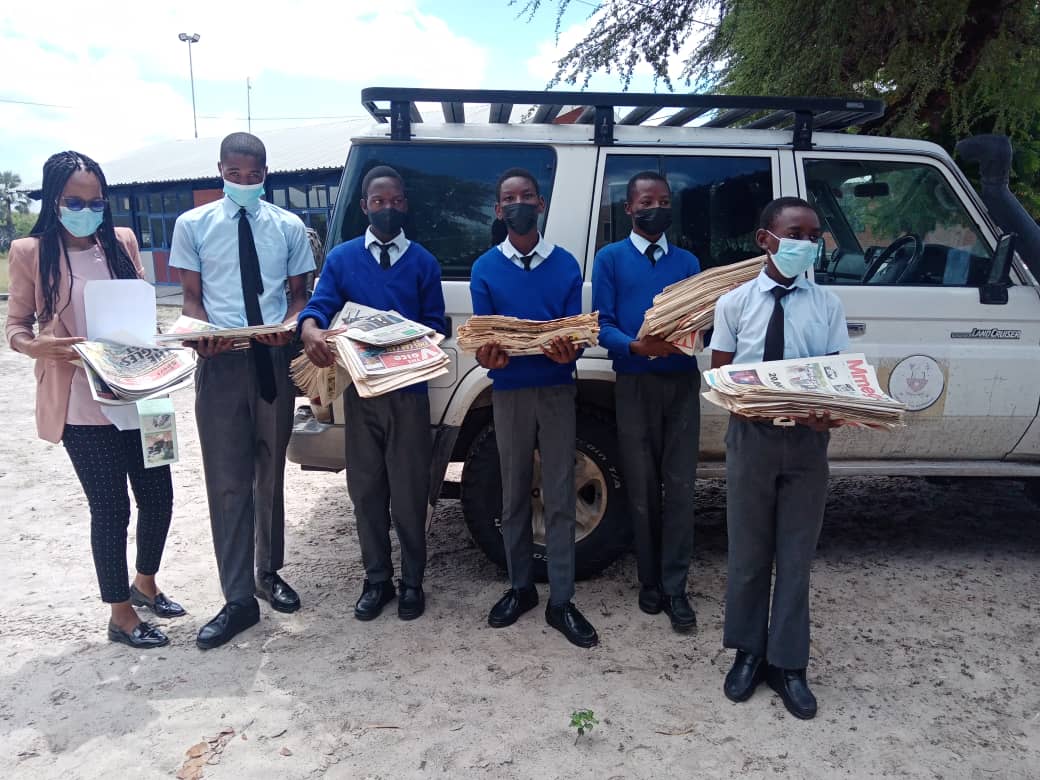
 Okavango Research Institute (ORI) has donated old newspapers to two secondary schools in Maun. The secondary schools that received the donations for their libraries and art departments are Tsodilo and Maitlamo Junior Secondary Schools.

ORI made the donations as part of its quest to create institutional linkages through partnerships and promotion of school libraries in the Northwest District. The schools normally use old newspapers to make sculptures. Art teachers at the two schools also said they used the newspapers for research as part of final junior certificate projects.

Receiving the donations, Tsodilo and Maitlamo JSS Deputy SchoolNewspapers Heads expressed gratitude, saying that the material would become handy during their Form Three class initiatives especially for intensive reading training and comprehension.

They noted that the donations were timely given that they needed material to set questions from stories from old newspapers as well as to guide students on how to answer questions across subjects. Both the Art students and teachers thanked ORI for the donation and asked for more.

Tuesday, February 15, 2022

Okavango Collections: Sharing Environmental Information Resources of the Cubango-Okavango River Basin

Abstract 

By Richard T. Cooper, Monica Morrison

This paper provides an account of the development of the web-based Okavango Collections (OC) metadata catalogue. In light of climate change, growing population, and developmental pressures on the transboundary CubangoOkavango river basin, there is an urgent need to ensure timely access to reliable environmental data and information for environmental decision-making. Commissioned by the Permanent Okavango River Basin Water Commission (OKACOM), OC provides a searchable directory of collections of data, data sets, image archives, books, reports and other information available both in the region and in other parts of the world. It is based on GeoNetwork Opensource, a standards-based and open source web catalogue, implementing international standards for metadata content and system interoperability. Its main features include a geospatial catalogue application, providing metadata editing and advanced search and discovery capabilities, and an integrated map viewer. Key development challenges included the creation of a regional geographic names thesaurus as a controlled vocabulary for place keywords, an email notification system to facilitate ongoing maintenance of metadata records, and enhancing search and discovery functionality. In addition to providing an important environmental information service for the Cubango-Okavango region, OC potentially offers a model system for implementation elsewhere. This work is licensed under the Creative Commons Attribution-Non commercial Works 3

https://www.academia.edu/4194305/Okavango_Collections_Sharing_Environmental_Information_Resources_of_the_Cubango_Okavango_River_Basin?email_work_card=title 

Monday, January 25, 2021

THE RANKS UB BOTSWANA'S PREMIER INSTITUTION OF HIGHER LEARNING

 The 2020/21 Times Higher Education (THE) World University Rankings Report has placed the University of Botswana at the top, cementing its national standing as Botswana’s premier institution of higher learning.

According to the report, University of Botswana is ranked number one in Botswana, giving it a premier national standing. In Africa the University of Botswana is ranked 27th while globally it is ranked 1068. Placing 27 in Africa means the University of Botswana is among the Top 30 highly recognized and competitive universities in the continent as per the 2021 Times Higher Education ranked African universities.
Other universities which submitted their data for ranking in southern, central and eastern Africa were University of Cape Town, University of Witwatersrand, Stellenbosch University, University of KwaZulu Natal and Durban University of Technology.
Others were Makerere University, North West University, University of Johannesburg, University of Nairobi, University of Pretoria, University of the Western Cape, University of South Africa and Tshwane University of Technology. All these were ranked among the Top 30 Universities in Africa.
The ranking was based on two sources of data. The first was institutional data provided directly by the university through the Department of Institutional Planning. The second data source was the bibliometric analysis of the university publications sources by the Times Higher Education partner Elsevier from the Scopus data base. The third source was an Academic Reputation Survey sent to academic colleagues which measures the perceived reputation of each university in terms of teaching and research.
However, given it was the first year UB participated, the survey was not administered but will be undertaken for subsequent evaluations. There are three widely observed and recognized international rankings of universities which are deemed to be objective and valid. These are Times Higher Education World University Rankings, QS World University Rankings and the Academic Ranking of World Universities (Shanghai Ranking).
There are additional global rankings with the most popular one being Ranking Web or Webometrics which provides rankings of several thousands of higher education institutions across the globe based on web presence and web impact.
While university rankings and league tables are frequently controversial, there is no common set of metrics of performance indicators used by various compilers of university league tables, nonetheless they are increasingly important as a reflection of the university’s national, regional and international standing and competitiveness.
With the University of Botswana’s previous Vision of becoming a distinctive centre of academic excellence in Botswana, Africa and globally, and with the increasing competition for students and resources, it has become imperative for the University of Botswana to maintain its number one spot in Botswana besides aiming to be in the Top 10 in Africa and Top 500 globally. Its new Vision is Creating a Future for the Knowledge Generation which aligns with Botswana development agenda of creating a knowledge-based society and economy.

Friday, January 22, 2021

Sedadama’s kingdom reaches a savage chapter

Belmond Safaris invited Mmegi’s intrepid traveller THALEFANG CHARLES* to their luxury camp in Savuti to catch up with the status of the world famous Savuti Marsh pride of lions and how they are doing after a long period without tourists

By THALEFANG CHARLES 

The last time something extraordinary happened here was in 2011 when the Savuti channel was flooding after a long period of dryness. But guides in the Savuti are adamant, saying they had a sense that something was about to happen.

Throughout the years, events of Savuti have made amazing legends that were told to the world through incredible nature documentaries. From the intermittent flooding of the mystic Savuti Channel to the unbelievable fishing leopards and extremely successful pride of lions, Savuti, is a place of wonder. Located on the western-end of Chobe Game Reserve, on the flood plains of the endless marsh, overlooked by a white sand ridge, dotted with small hills, this is a place of remarkable legends.

The marsh is where the river, during the years that it magically floods, empties the waters from Kwando and Linyanti. These are the floodplains of the nutritious grasslands that feed hundreds of thousands of migrating zebras, wildebeests, kudus, impalas, warthogs and incredible birdlife. There are so many Kori Bustards – Botswana’s National Bird – and other families of large birds, including marabou storks, cranes, eagles, secretary birds and ostriches.

Large herds of elephants, buffalos, and giraffes are all found in Savuti. And with all that plentiful game, the place attracts lots of predators. Lions, cheetahs, leopards, hyenas and wild dogs roam the place.

Back in the 1980s, the Savuti Marsh pride of lions earned worldwide fame because of their ability to hunt elephants. The 1980s vicious pride boasted of more than 40 lions. It had some of the world’s most wild efficient killing machines. But one day the kingdom crumbled.


Read more https://www.mmegi.bw/index.php?aid=88092&dir=2020%2Fdecember%2F11&fbclid=IwAR20K1lB5Bza0qVrGL8orz3p3DdoCsM82tl0fmjvldwTM2jMUcu3MxIeFsA

Hope in Aging and Dementia!